Three kinds, one question
Real-Money Play in the US: Sweepstakes, Licensed, and Crypto Casinos
Real money online play in the US splits three ways: sweepstakes redemptions paid under each site's own rules, a handful of state-licensed casinos, and offshore crypto casinos that hold a real balance from the first deposit. We ran two real-money tests at crypto casinos, one of them our advertiser, on 28 August 2026, and this page lines up how funds move at each kind.
Three kinds of real money, not one
A reader whose sweepstakes site closed, cut its Sweeps Coins, or asked for ID for the first time is usually looking for the next place to put money down — the kind of search behind sweepstakes casino alternatives generally. There are three different transactions hiding under that one search, and they are not interchangeable.
The first is a sweepstakes redemption: you buy Gold Coins, play with a second currency called Sweeps Coins, and — if you clear a brand's minimum and playthrough — that second currency becomes cash or a gift card. The second is a state-licensed online casino: a small number of states issue an actual gambling licence to an operator, and every dollar in the account is a deposit from the start. The third is an offshore crypto casino: no sweepstakes structure, no state licence, a licence from an offshore gaming authority instead, and a balance that is real cryptocurrency from the moment it lands.
This page compares what each one gives a player: how money goes in, how it comes out, what identity checks apply, and what “real money” actually means once you are inside the account. The law that decides which of these a resident of a given state can use sits on one page only, linked below; this page is about what the operators themselves offer.
What real money means at each one
“Real money” gets used loosely. At a sweepstakes site it means the second currency, Sweeps Coins, which the operator's own rules say may be redeemed for a prize once conditions are met — nothing is redeemable before that point, and Gold Coins on their own never are. LuckyLand Slots' Sweeps Rules put it plainly: Gold Coins cannot be redeemed for prizes, while Sweeps Coins won through play “can be redeemed for a prize with the value being equivalent to US$1” (Sweeps Rules 4.4, read 7 September 2026).
At a state-licensed casino, “real money” means the deposit itself — there is no second currency and no playthrough step standing between a deposit and a withdrawal beyond ordinary wagering.
At an offshore crypto casino, “real money” means the crypto balance you funded. Vave's own money test on 28 August 2026 — deposit, play, and withdrawal — moved that way: a deposit became a balance, and a withdrawal returned cryptocurrency with no ID requested up to 5,000 USDT. TrustDice, tested in May 2026, returned crypto withdrawals in 10 to 15 minutes each, also with no ID requested until roughly 5,000 USDT had been withdrawn, at which point verification began.
How money goes in
| Kind | What a deposit is | How you put it in |
|---|---|---|
| Sweepstakes redemption | A purchase of Gold Coins; Sweeps Coins usually arrive as a bonus attached to that purchase, or free | Card, online wallet, or bank account at most brands we read; Stake.us and PlayFame both name cryptocurrency as a purchase option alongside fiat, and Spree's own FAQ mentions crypto without naming a coin |
| State-licensed casino | A cash deposit into a regulated gaming account | Bank transfer, card, or a state-approved payment method, under licence conditions |
| Offshore crypto casino | A transfer of cryptocurrency to the casino's own deposit address | Crypto sent from a wallet or exchange; some operators, such as Bitsler, also list a card purchase of crypto as a deposit route |
Most sweepstakes documents we read do not mention cryptocurrency as a purchase method. LuckyLand Slots' Terms of Service define a “Payment Medium” only as “any card, online wallet, financial/bank account or other payment medium” (ToS 1, read via Wayback capture 12 December 2025) — crypto is absent from that definition. Zula Casino's terms name only credit cards and ACH-style payments (read 11 September 2026). Rolla's terms verify “the credit/debit card, online wallet and/or a financial/bank account” used for a Gold Coin purchase, again with no coin named (read 11 September 2026). Stake.us and PlayFame are exceptions on this point, and Sweeptastic named specific coins — BTC, ETH, LTC, USDT and USDC — before it stopped operating as a playable platform; the full brand-by-brand picture is on its own page.
How money comes out
| Kind | What leaves the account | Method |
|---|---|---|
| Sweepstakes redemption | Sweeps Coins won through play, converted at each brand's own rate (commonly 1 SC = US$1) once a minimum and a playthrough are cleared | Cash to the original payment method, or in some cases a gift card; LuckyLand Slots states up to 10 business days for a bank payout (ToS 8.16) |
| State-licensed casino | A cash withdrawal | Bank transfer or card refund, on the timeline the licensed operator sets |
| Offshore crypto casino | Cryptocurrency | Sent to your own wallet address; our own tests put Vave and TrustDice in the minutes-to-an-hour range, and the wider table below shows what other operators state |
A sweepstakes redemption is never instant by design: it carries a playthrough step first. LuckyLand Slots requires Sweeps Coins to be “played once before they are eligible to be redeemed for prizes,” with the operator reserving the right to raise that “not exceeding 20” times (Sweeps Rules 4.6). Stake.us sets its own playthrough at three times before Stake Cash is eligible for redemption (Terms and Conditions 13.1(c), read via Wayback capture 8 September 2026). A crypto casino deposit, by contrast, is playable and withdrawable without that structure, though several operators still apply a smaller wagering step of their own — more on that below.
What ID checks each one asks
Every kind of real-money play we read asks for identity verification somewhere in its documents. None of them skip it entirely; the difference is when it is triggered and what threshold, if any, is published.
Sweepstakes brands generally tie verification to redemption rather than to sign-up. Stake.us states plainly that “no Prize can be redeemed without completing the identification process” (Terms and Conditions 13.1(e)). LuckyLand Slots holds any redemption request pending until checks pass, with extra checks required “for any cumulative or single redemption of Prizes equivalent to or exceeding US$2,000” (ToS 9.2, 9.3). Zula Casino asks for photo ID, proof of residence, and proof of income once a redemption is requested, with extra checks over $2,000 (Sweeps Rules 5.9, 5.10).
Crypto casinos vary more, and some publish nothing at all. Bitcasino.io names an actual figure: extra verification above EUR 2,500 on a withdrawal, plus random account checks that “do not need to be based on any specific triggers” (Terms of Service 6.6, 3.13, captured 2 September 2026). Cloudbet's own terms describe a risk-based process without naming an amount (clause 18.1.1, archived read 26 August 2026). Shuffle “may request KYC documentation at any time if it deems necessary” with no figure printed (Terms 4.1, read 8 September 2026). TrustDice's own terms did not state a KYC type in the documents we read; our money test found no ID requested until roughly 5,000 USDT had been withdrawn.
Which state allows which kind of play, and which brands have exited which state, is a separate question with its own answer, not covered here.
Sweepstakes redemptions, in the brands' own words
A full comparison of the two-coin model across the brands we read is its own page, and how Sweeps Coins turn into cash or a gift card is covered brand by brand elsewhere. The short version: every brand we read pairs a non-redeemable Gold Coin with a second, redeemable currency, sets a minimum redemption amount, and applies a playthrough before that currency can be cashed out. None of the four brands' documents we read contain a clause about the service stopping permanently, which is a separate question covered on our page about unredeemed coins.
State-licensed online casinos
A number of US states issue an actual gambling licence for an online casino; most do not, and that split — along with which brands have exited which states — belongs entirely on our dedicated legal page. What we can say here, from the operators' side rather than the law's: where a state-licensed casino exists, the deposit is cash from the first transaction, the withdrawal is cash, and there is no second currency standing between the two.
Offshore crypto casinos: our advertiser
Vave is our advertiser — a real-money crypto casino, not a sweepstakes site, licensed by the Curaçao Gaming Authority under number OGL/2024/1676/0905, issued to Latcas B.V. and listed as Active as of 19 May 2025. Its cashier takes six coins: BTC, ETH, USDT, LTC, DOGE, and TON.
Its promotions page, read 24 August 2026, lists a 150% match up to 1.5 BTC plus 100 free spins on a first deposit, then 100% up to 1 BTC, 50% up to 1 BTC, and 25% up to 0.5 BTC on further deposits — that page states no wagering multiple. Our own money test on 28 August 2026 covered a deposit, play, and a withdrawal, and no ID was requested up to 5,000 USDT.
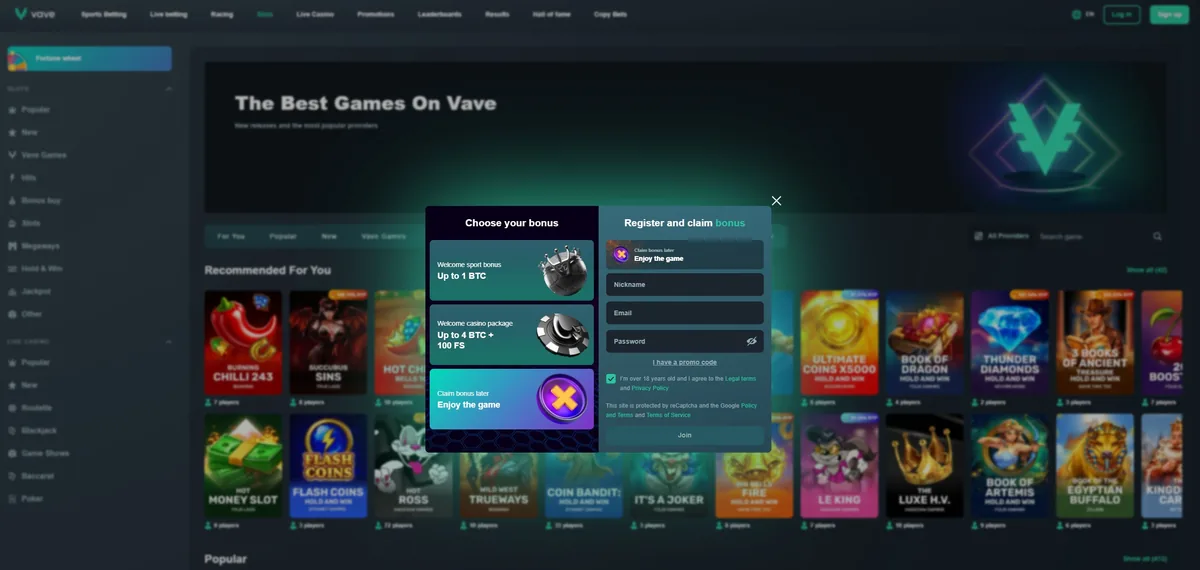
Vave is a real-money crypto casino, not a sweepstakes site: sports and casino sit behind one login, and there is no Gold Coin or Sweeps Coin anywhere in it. The sign-up window asks for a sport bonus or a casino package before the first deposit.
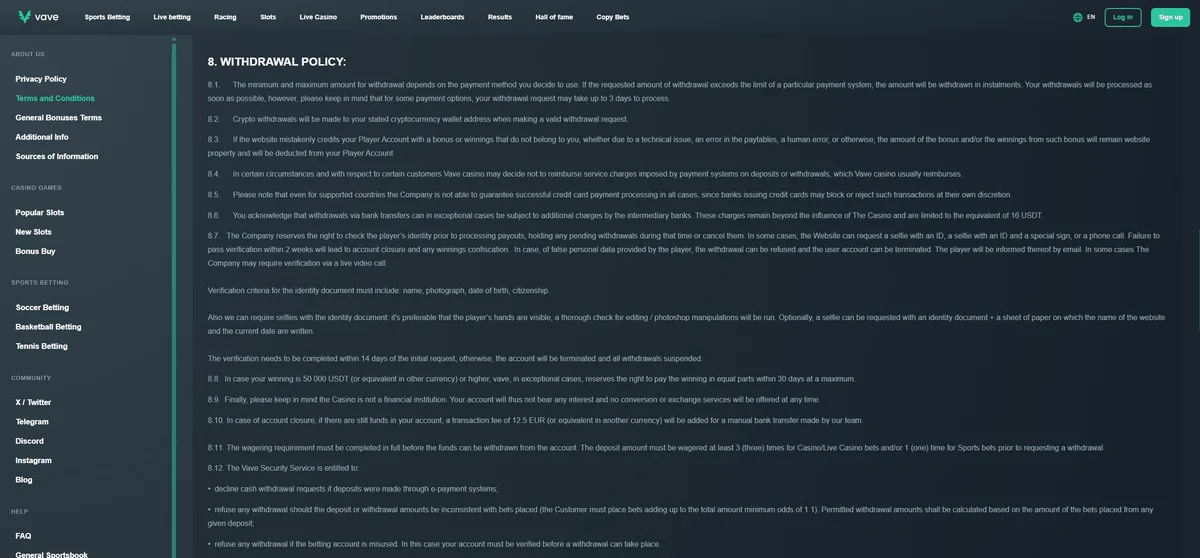
Clause 8.7 lets Vave ask for ID before any payout, with 14 days to reply; clause 8.8 lets a win of 50,000 USDT or more be paid in instalments over up to 30 days. In our own test on 28 August 2026, no ID was asked up to 5,000 USDT.

Vave's own footer names Changelly as the partner behind its Buy crypto button and shows a row of coin icons for payment, Bitcoin among them — a crypto-only cashier, with no card or bank logo printed on this strip.
Other crypto casinos, compared
Vave is not the only offshore crypto casino a reader will meet. The table below lines up six others by what their own documents say — licence, coins, KYC wording, and stated withdrawal time — each with the date we read it.
| Casino | Licence (register) | Coins | KYC, in the operator's own wording | Stated withdrawal |
|---|---|---|---|---|
| Shuffle | Curaçao Gaming Authority OGL/2024/1337/0628, Active (26 Aug 2026) | Not totalled; cashier is behind login (clause 9.4/10.6, 8 Sep 2026) | May request KYC documentation at any time if deemed necessary (clause 4.1) | No processing time or per-period cap printed (8 Sep 2026) |
| Wild.io | Curaçao OGL/2024/210/0198, Active; also Anjouan ALSI-202504044-FI2, valid (26 Aug 2026) | 12 listed, including BTC, ETH, LTC, USDT | Documents may be requested at any time at its discretion, also before a first withdrawal | 10 to 60 minutes stated; cap $100,000 a week (clause 9.6) |
| Rainbet | Anjouan ALSI-152406029-FI2, valid (2 Sep 2026) | No total published; BTC, ETH, LTC, XRP, SOL, TRX, BNB, USDT, USDC named, plus bank transfer and cards | May ask for KYC at any time to determine identity and location; up to 7 business days to review (clause 20.1) | Homepage states 5 to 15 minutes typically; not tested by us (2 Sep 2026) |
| TrustDice | Curaçao OGL/2024/664/0280, Active; also Anjouan ALSI-202605020-FI1, valid (26 Aug 2026) | 9 listed, including BTC, ETH, USDT, LTC | Not stated in the documents we read | 3 to 60 minutes stated; no per-period cap read |
| Cloudbet | Curaçao OGL/2024/328/0599, Active (26 Aug 2026) | 40 listed, including BTC, ETH, USDT, USDC | Risk-based verification (clause 18.1.1); no amount named | 10 to 120 minutes stated; no cap read |
| Bitcasino.io | Curaçao OGL/2023/111/0069, Active; also Anjouan ALSI-202509076-FI2, valid (2 Sep 2026) | 12 listed, including BTC, ETH, LTC, USDT | Extra checks above EUR 2,500 on a withdrawal; random account checks need no trigger (clauses 6.6, 3.13) | Fiat up to 3 business days (clause 6.1); no crypto processing time stated |
None of these six carry a paid placement on this site; Vave is the only advertiser. Their licence numbers can be checked directly against the Curaçao and Anjouan registers named in the table. A fuller point-by-point comparison of the two-coin sweepstakes model against a crypto balance, including both of our money tests, is on its own page.
Which kind fits which reader
A reader who wants free entry and does not mind a redemption threshold and a playthrough stays with a sweepstakes casino or a social casino with no prize currency at all. A reader in a state that licenses an online casino directly has a cash-from-day-one option, covered on the legal page. A reader who wants a single real balance, funded and withdrawn in cryptocurrency, with no second currency and no redemption threshold, is looking at an offshore crypto casino — and can start from what our advertiser gives, above, or the wider table. Whichever path fits, the same caution applies everywhere on this site: a block on a state or a country is the operator's decision, not something to work around, and every figure above carries the date we read it.